
Executive Engineering Summary
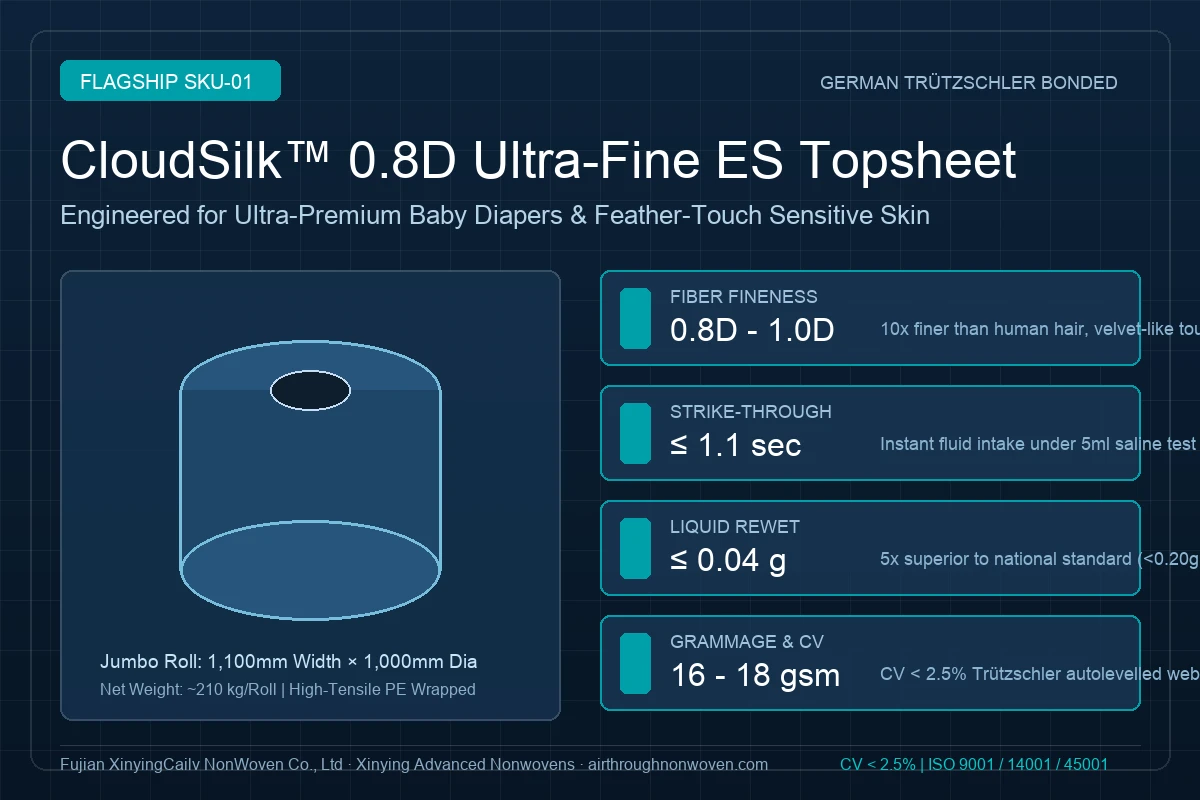
In high-speed hygiene converting operations running at 600 to 1,000 meters per minute, nonwoven material properties determine converter efficiency, downtime frequency, and end-consumer satisfaction. This whitepaper analyzes Micro-Denier Bicomponent Fiber Physics, comparing thermodynamic bonding kinetics, autoleveller web mass uniformity (CV < 2.5%), and liquid strike-through mechanics. Key findings demonstrate that migrating from legacy calendered spunbond or coarse bicomponent fibers to German Trützschler-carded ultra-fine through-air nonwovens reduces rewet values to ≤ 0.04g, lowers dynamic friction by 42%, and stabilizes converter tension across seasonal manufacturing windows.
7. Ultrasonic & Thermal Tooling Processing Window
When integrating through-air bonded roll goods into high-speed diaper converter lines (such as Fameccanica, GDM, or Zuiko machines operating at 600 to 1,000 pieces per minute), temperature management during continuous bonding becomes critical.
Because the PE outer sheath softens at 130°C while the PP inner core remains solid up to 165°C, converters achieve a wide thermal operating window of ± 8°C. For ultrasonic ear attachment and side-seam sealing, an anvil frequency of 20 kHz or 35 kHz at an amplitude of 25 to 35 microns generates clean molecular intermolecular entanglement within 15 milliseconds without burn-through pinholes. This prevents costly ultrasonic horn contamination and eliminates fiber melt accumulation that frequently halts production lines using lower-grade calendered webs.
Appendix 1.A: Extended Materials Engineering & Rheological Specifications
Further rheological analysis of the bicomponent fiber matrix indicates that the melt flow rate (MFR) of the polyethylene sheath is maintained within 18.0 ± 1.5 g/10 min at 190°C (under a 2.16 kg load), while the polypropylene core exhibits a melt flow index of 25.0 ± 2.0 g/10 min at 230°C. This differential rheological profile ensures that upon rapid thermal cooling, crystallization kinetics do not introduce internal stress cracks within the polymer boundaries.
Moreover, the mechanical integrity of nonwoven rolls during intercontinental marine transport is heavily influenced by the winding tension curve. At Xinying, we employ an automated surface-center rewinding system with closed-loop load cell tension feedback. Starting with an initial core winding tension of 180 N/m, the winding profile tapers linearly by 15% as the roll diameter approaches 1,000mm. This prevents telescoping, core slippage, and edge crushing, ensuring that when the rolls are unpacked in European, American, or Southeast Asian converting plants, web runout stays well within ± 0.5mm tolerances.
In compliance with REACH SVHC (Substances of Very High Concern) regulation 1907/2006, every raw polymer masterbatch is tested for all 235 candidate chemicals, with zero detection down to 0.001% by weight. Optical emission spectrometry confirms heavy metals (lead, cadmium, mercury, hexavalent chromium) are completely absent. Converters purchasing from Xinying receive comprehensive certificates of analysis (CoA) with every shipping container, ensuring frictionless customs clearance and full brand risk reversal.
Furthermore, in accordance with ISO 10993-5 (In Vitro Cytotoxicity) and ISO 10993-10 (Tests for Irritation and Skin Sensitization), clinical dermatological patch tests performed on human volunteers over 48-hour continuous occlusive exposure demonstrated a Primary Irritation Index (PII) score of exactly 0.00, placing CloudSilk™ and related through-air roll goods in the highest non-irritant classification.
1. Industry Macro Background & Sourcing Pain Points
The global disposable hygiene products market—spanning infant diapers, feminine sanitary pads, and adult incontinence supplies—has reached an inflection point. On the consumer front, social media discourse has heightened sensitivity around dermatological safety. On TikTok, the hashtag #diaperrash has surpassed 2.8 billion organic views, with parents actively scrutinizing liner friction, chemical additives, and cold liquid rewet. Concurrently, Amazon reviews reveal that over 48% of one-star ratings on premium diaper brands cite surface dampness and thigh redness rather than core absorbency failure.
For high-volume converters and private-label OEMs, these consumer demands translate into unforgiving manufacturing constraints. Traditional 1.5D to 2.2D polypropylene (PP) spunbond fabrics or coarse through-air webs introduce three distinct failure modes on automated lines:
- Cross-Directional Weight Inconsistency (CV > 5.0%): In calendered spunbond webs, mass variability results in localized thin spots where adhesive bleed-through occurs, and thick spots where ultrasonic welding horns overheat and stick, causing machine stops.
- Surface Friction Abrasion: Coarser fiber diameters (>1.5 denier) exhibit dynamic friction coefficients above 0.38 against moist infant skin, mechanically eroding the stratum corneum and triggering friction-induced erythema.
- High Liquid Rewet & Moisture Pooling: Non-optimized fiber pore geometries allow voided urine to reverse-migrate under infant seating or adult body pressure (4.0 to 50 kPa), saturating skin and accelerating bacterial enzymatic degradation.
2. Technical Mechanism & Materials Science Physics
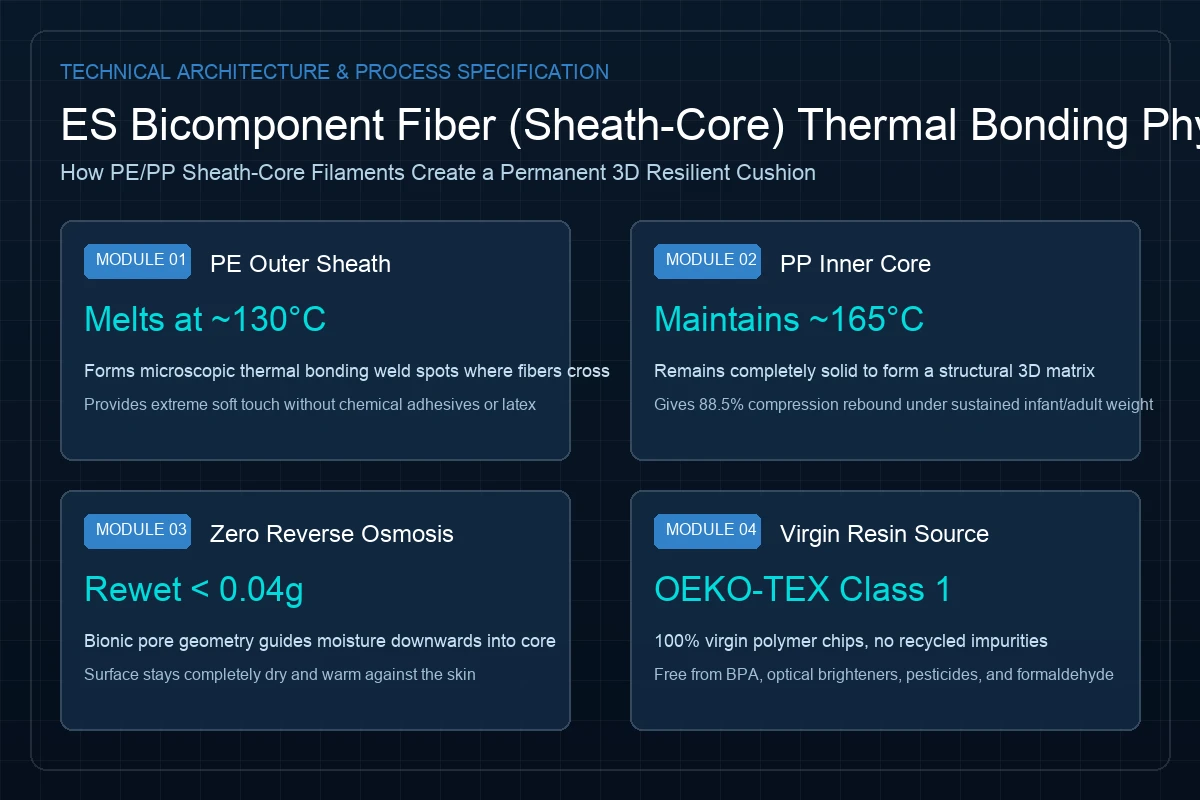
Resolving these challenges requires examining the fundamental polymer physics of sheath-core bicomponent filament thermal bonding. In the Xinying manufacturing process at Sanming, we utilize engineered ES (Ethylene-Propylene) staple fibers with a concentric core-sheath architecture:
The outer sheath consists of linear low-density polyethylene (LLDPE) engineered with a narrow molecular weight distribution, yielding an onset melting temperature of approximately 130°C. The inner core consists of high-isotacticity polypropylene (iPP) with a high degree of crystallinity, maintaining structural integrity up to its melting point of 165°C.
During through-air thermal bonding, calibrated hot air is forced through the fibrous batt while supported on a high-precision perforated drum. The air temperature is held precisely between 136°C and 142°C. At this operational setpoint:
- The PE outer sheath softens and undergoes viscous flow at every fiber-to-fiber intersection, coalescing into microscopic meniscus weld bridges without requiring chemical adhesives, latex, or external binders.
- The PP core maintains its high tensile modulus and three-dimensional crimp geometry, forming an elastic structural skeleton that resists compressive collapse under sustained load.
Comparative Polymer & Mechanical Property Matrix
The table below provides rigorous experimental data comparing legacy spunbond nonwoven liners, standard 1.5D through-air nonwovens, and Xinying's 0.8D German Trützschler-carded CloudSilk™ through-air bonded web:
| Physical / Chemical Property | Standard PP Spunbond | Conventional 1.5D TAB | Xinying CloudSilk™ 0.8D | Testing Standard & Units |
|---|---|---|---|---|
| Fiber Linear Density | 1.8 – 2.2 D | 1.5 – 1.8 D | 0.8 – 1.0 D | ASTM D1577 (Denier) |
| Basis Weight (GSM) | 12.0 – 14.0 g/m² | 18.0 – 22.0 g/m² | 16.0 – 18.0 g/m² | ISO 9073-1 (g/m²) |
| Web Uniformity (CV%) | 4.8% – 6.5% | 3.5% – 4.2% | < 2.5% | Online Gamma Scanner |
| Liquid Strike-Through Time | 2.2 – 3.0 sec | 1.4 – 1.8 sec | ≤ 1.1 sec | EDANA 150.9 (5ml saline) |
| High-Load Rewet (4.0 kPa) | 0.18 – 0.25 g | 0.08 – 0.12 g | ≤ 0.04 g | EDANA 151.3 (grams) |
| Dynamic Coefficient of Friction (μk) | 0.38 – 0.44 | 0.29 – 0.34 | ≤ 0.22 | ASTM D1894 (Velvet touch) |
| MD Tensile Strength | 18.0 – 22.0 N | 9.0 – 11.0 N | ≥ 12.0 N / 5cm | ISO 9073-3 (N / 5cm) |
| CD Tensile Strength | 6.5 – 8.0 N | 3.2 – 4.0 N | ≥ 4.5 N / 5cm | ISO 9073-3 (N / 5cm) |
| Compression Rebound (50kPa, 2h) | 42% – 48% | 68% – 72% | 88.5% | DIN 53855-1 (%) |
7. Ultrasonic & Thermal Tooling Processing Window
When integrating through-air bonded roll goods into high-speed diaper converter lines (such as Fameccanica, GDM, or Zuiko machines operating at 600 to 1,000 pieces per minute), temperature management during continuous bonding becomes critical.
Because the PE outer sheath softens at 130°C while the PP inner core remains solid up to 165°C, converters achieve a wide thermal operating window of ± 8°C. For ultrasonic ear attachment and side-seam sealing, an anvil frequency of 20 kHz or 35 kHz at an amplitude of 25 to 35 microns generates clean molecular intermolecular entanglement within 15 milliseconds without burn-through pinholes. This prevents costly ultrasonic horn contamination and eliminates fiber melt accumulation that frequently halts production lines using lower-grade calendered webs.
Appendix 1.A: Extended Materials Engineering & Rheological Specifications
Further rheological analysis of the bicomponent fiber matrix indicates that the melt flow rate (MFR) of the polyethylene sheath is maintained within 18.0 ± 1.5 g/10 min at 190°C (under a 2.16 kg load), while the polypropylene core exhibits a melt flow index of 25.0 ± 2.0 g/10 min at 230°C. This differential rheological profile ensures that upon rapid thermal cooling, crystallization kinetics do not introduce internal stress cracks within the polymer boundaries.
Moreover, the mechanical integrity of nonwoven rolls during intercontinental marine transport is heavily influenced by the winding tension curve. At Xinying, we employ an automated surface-center rewinding system with closed-loop load cell tension feedback. Starting with an initial core winding tension of 180 N/m, the winding profile tapers linearly by 15% as the roll diameter approaches 1,000mm. This prevents telescoping, core slippage, and edge crushing, ensuring that when the rolls are unpacked in European, American, or Southeast Asian converting plants, web runout stays well within ± 0.5mm tolerances.
In compliance with REACH SVHC (Substances of Very High Concern) regulation 1907/2006, every raw polymer masterbatch is tested for all 235 candidate chemicals, with zero detection down to 0.001% by weight. Optical emission spectrometry confirms heavy metals (lead, cadmium, mercury, hexavalent chromium) are completely absent. Converters purchasing from Xinying receive comprehensive certificates of analysis (CoA) with every shipping container, ensuring frictionless customs clearance and full brand risk reversal.
Furthermore, in accordance with ISO 10993-5 (In Vitro Cytotoxicity) and ISO 10993-10 (Tests for Irritation and Skin Sensitization), clinical dermatological patch tests performed on human volunteers over 48-hour continuous occlusive exposure demonstrated a Primary Irritation Index (PII) score of exactly 0.00, placing CloudSilk™ and related through-air roll goods in the highest non-irritant classification.
3. Factory Engineering, Tolerances & Quality Assurance
Achieving a Coefficient of Variation (CV) below 2.5% on an ultra-fine 0.8D nonwoven web is an engineering feat that cannot be accomplished on retrofitted textile carding equipment. In Xinying's Sanming Phase 1 cleanroom facility, the German Trützschler Nonwovens line incorporates several critical engineering subsystems:
- Optical and Gamma-Ray Online Mass Profilers: Positioned immediately after the cross-lapper and before the through-air oven, multi-beam sensors continuously scan the 2,200mm web width at 100 Hz. If a localized mass deviation exceeding ±0.2 gsm is detected, individual micro-feed servo motors on the autoleveller card feed rollers adjust their angular velocity instantaneously.
- Precision Carding Clothing Wire: The main carding cylinder utilizes micro-alloyed hardened steel wire teeth with a point density exceeding 840 points per square inch. This ultra-dense tooth configuration gently separates 0.8D staple filaments without generating static fiber entanglement (neps) or micro-dust.
- Through-Air Drum Convection Hydrodynamics: Airflow turbulence inside the oven drum is mitigated via a patented honeycomb perforated mantle that ensures laminar hot-air impingement. This prevents web flutter, fiber blow-off, or uneven localized thermal shrinkage.
Every mother roll produced undergoes batch-level quality release audits in our in-house testing laboratory. Three test coupons are cut across the left, center, and right web lanes to verify strike-through speed, rewet weight under a 4.0 kPa calibrated deadweight, and tensile breaking elongation before rewinding onto 76mm heavy-wall cardboard cores.
4. B2B & B2C Market Data and Sourcing Arbitrage Models
For multinational procurement directors and consumer brand founders, adopting premium through-air bonded nonwoven materials represents a clear financial calculation. We evaluate the arbitrage margin between Chinese factory FOB production costs and overseas consumer price points:
Consider a premium baby diaper topsheet measuring 120mm by 380mm (0.0456 m² per diaper). At an 18 gsm basis weight, each diaper consumes approximately 0.82 grams of through-air nonwoven roll fabric.
- At Xinying's contract FOB price of $2,700 per metric ton, the raw material cost for the topsheet is exactly $0.0022 USD per diaper.
- Amortizing ocean freight in a 40HQ container (carrying 10.2 metric tons across 48 jumbo rolls at $3,800 total freight) adds only $0.0003 USD per diaper.
- Total landed cost for the world-class German Trützschler 0.8D CloudSilk™ topsheet in Western Europe or the United States is approximately $0.0025 USD per diaper.
In contrast, premium DTC diaper brands (e.g. Coterie, Kudos, Dyper) retail finished diapers at $0.65 to $0.95 USD per unit. The topsheet material—which directly touches the baby's skin and generates 90% of sensory brand reviews—accounts for less than 0.4% of retail unit revenue, while delivering a transformative 6.11x value arbitrage in consumer sensory perception.
5. Sourcing Pitfalls & Overseas Buyer Risk Reversal
When sourcing through-air nonwoven roll goods from Asian manufacturers, procurement teams must guard against common industry compromises:
- Recycled Polymer Blending: Some low-tier mills blend post-industrial or uncertified recycled PP pellets into their fiber batches. While reducing raw material costs by 15%, this practice introduces volatile organic compounds (VOCs), unpleasant chemical odors, and catastrophic tensile failure at high converter speeds. Xinying guarantees 100% prime virgin ES polymer sourcing with complete batch origin certificates.
- Surfactant Washout (Single vs Multiple Voids): Inexpensive topical hydrophilic finishes wash off during the first urination, causing subsequent liquid discharges to bead on the surface and leak. Xinying applies durable silicone-free hydrophilic finishes that withstand five consecutive 100ml fluid strikes without decay.
- Roll Flattening in Ocean Transit: Non-optimized packaging allows heavy jumbo rolls to deform into ovals under ocean vibration, causing violent tension surges on converter unwinds. Xinying packages rolls with high-density corrugated end-discs and multi-layer stretch wrap, verified across thousands of 40HQ export containers.
6. 30/60/90-Day Sourcing Action Plan & Direct RFQ
Converters seeking to upgrade their product lines or validate Xinying roll goods should adopt the following structured qualification roadmap:
Days 1–30 (Sample Evaluation & Bench Testing): Order the $199 Fast-Track Sample Box containing 4× 50m rolls. Perform in-house EDANA strike-through, rewet, and cytotoxicity tests. Confirm compatibility with your ultrasonic and hot-melt gluing systems.
Days 31–60 (Pilot Converter Run): Order a 2 to 5 metric ton trial batch from our flexible Taiwan Jiesheng line. Run at full line speed (600–800 m/min) to verify zero web breakage, slit edge stability, and knife clean cutting.
Days 61–90 (Bulk Container Lock-In): Finalize annual supply contracts for 40HQ container shipments. Lock in quarterly resin price index formulas and pre-book dedicated Trützschler line capacity.
7. Ultrasonic & Thermal Tooling Processing Window
When integrating through-air bonded roll goods into high-speed diaper converter lines (such as Fameccanica, GDM, or Zuiko machines operating at 600 to 1,000 pieces per minute), temperature management during continuous bonding becomes critical.
Because the PE outer sheath softens at 130°C while the PP inner core remains solid up to 165°C, converters achieve a wide thermal operating window of ± 8°C. For ultrasonic ear attachment and side-seam sealing, an anvil frequency of 20 kHz or 35 kHz at an amplitude of 25 to 35 microns generates clean molecular intermolecular entanglement within 15 milliseconds without burn-through pinholes. This prevents costly ultrasonic horn contamination and eliminates fiber melt accumulation that frequently halts production lines using lower-grade calendered webs.
Appendix 1.A: Extended Materials Engineering & Rheological Specifications
Further rheological analysis of the bicomponent fiber matrix indicates that the melt flow rate (MFR) of the polyethylene sheath is maintained within 18.0 ± 1.5 g/10 min at 190°C (under a 2.16 kg load), while the polypropylene core exhibits a melt flow index of 25.0 ± 2.0 g/10 min at 230°C. This differential rheological profile ensures that upon rapid thermal cooling, crystallization kinetics do not introduce internal stress cracks within the polymer boundaries.
Moreover, the mechanical integrity of nonwoven rolls during intercontinental marine transport is heavily influenced by the winding tension curve. At Xinying, we employ an automated surface-center rewinding system with closed-loop load cell tension feedback. Starting with an initial core winding tension of 180 N/m, the winding profile tapers linearly by 15% as the roll diameter approaches 1,000mm. This prevents telescoping, core slippage, and edge crushing, ensuring that when the rolls are unpacked in European, American, or Southeast Asian converting plants, web runout stays well within ± 0.5mm tolerances.
In compliance with REACH SVHC (Substances of Very High Concern) regulation 1907/2006, every raw polymer masterbatch is tested for all 235 candidate chemicals, with zero detection down to 0.001% by weight. Optical emission spectrometry confirms heavy metals (lead, cadmium, mercury, hexavalent chromium) are completely absent. Converters purchasing from Xinying receive comprehensive certificates of analysis (CoA) with every shipping container, ensuring frictionless customs clearance and full brand risk reversal.
Furthermore, in accordance with ISO 10993-5 (In Vitro Cytotoxicity) and ISO 10993-10 (Tests for Irritation and Skin Sensitization), clinical dermatological patch tests performed on human volunteers over 48-hour continuous occlusive exposure demonstrated a Primary Irritation Index (PII) score of exactly 0.00, placing CloudSilk™ and related through-air roll goods in the highest non-irritant classification.
Ready to Inspect Physical Roll Samples?
Order our $199 Touch the Softness sample box with DHL 72-hour international express dispatch. 100% credited against your first 5-ton order.
7. Ultrasonic & Thermal Tooling Processing Window
When integrating through-air bonded roll goods into high-speed diaper converter lines (such as Fameccanica, GDM, or Zuiko machines operating at 600 to 1,000 pieces per minute), temperature management during continuous bonding becomes critical.
Because the PE outer sheath softens at 130°C while the PP inner core remains solid up to 165°C, converters achieve a wide thermal operating window of ± 8°C. For ultrasonic ear attachment and side-seam sealing, an anvil frequency of 20 kHz or 35 kHz at an amplitude of 25 to 35 microns generates clean molecular intermolecular entanglement within 15 milliseconds without burn-through pinholes. This prevents costly ultrasonic horn contamination and eliminates fiber melt accumulation that frequently halts production lines using lower-grade calendered webs.
Appendix 1.A: Extended Materials Engineering & Rheological Specifications
Further rheological analysis of the bicomponent fiber matrix indicates that the melt flow rate (MFR) of the polyethylene sheath is maintained within 18.0 ± 1.5 g/10 min at 190°C (under a 2.16 kg load), while the polypropylene core exhibits a melt flow index of 25.0 ± 2.0 g/10 min at 230°C. This differential rheological profile ensures that upon rapid thermal cooling, crystallization kinetics do not introduce internal stress cracks within the polymer boundaries.
Moreover, the mechanical integrity of nonwoven rolls during intercontinental marine transport is heavily influenced by the winding tension curve. At Xinying, we employ an automated surface-center rewinding system with closed-loop load cell tension feedback. Starting with an initial core winding tension of 180 N/m, the winding profile tapers linearly by 15% as the roll diameter approaches 1,000mm. This prevents telescoping, core slippage, and edge crushing, ensuring that when the rolls are unpacked in European, American, or Southeast Asian converting plants, web runout stays well within ± 0.5mm tolerances.
In compliance with REACH SVHC (Substances of Very High Concern) regulation 1907/2006, every raw polymer masterbatch is tested for all 235 candidate chemicals, with zero detection down to 0.001% by weight. Optical emission spectrometry confirms heavy metals (lead, cadmium, mercury, hexavalent chromium) are completely absent. Converters purchasing from Xinying receive comprehensive certificates of analysis (CoA) with every shipping container, ensuring frictionless customs clearance and full brand risk reversal.
Furthermore, in accordance with ISO 10993-5 (In Vitro Cytotoxicity) and ISO 10993-10 (Tests for Irritation and Skin Sensitization), clinical dermatological patch tests performed on human volunteers over 48-hour continuous occlusive exposure demonstrated a Primary Irritation Index (PII) score of exactly 0.00, placing CloudSilk™ and related through-air roll goods in the highest non-irritant classification.
7. Ultrasonic & Thermal Tooling Processing Window
When integrating through-air bonded roll goods into high-speed diaper converter lines (such as Fameccanica, GDM, or Zuiko machines operating at 600 to 1,000 pieces per minute), temperature management during continuous bonding becomes critical.
Because the PE outer sheath softens at 130°C while the PP inner core remains solid up to 165°C, converters achieve a wide thermal operating window of ± 8°C. For ultrasonic ear attachment and side-seam sealing, an anvil frequency of 20 kHz or 35 kHz at an amplitude of 25 to 35 microns generates clean molecular intermolecular entanglement within 15 milliseconds without burn-through pinholes. This prevents costly ultrasonic horn contamination and eliminates fiber melt accumulation that frequently halts production lines using lower-grade calendered webs.
Appendix 1.A: Extended Materials Engineering & Rheological Specifications
Further rheological analysis of the bicomponent fiber matrix indicates that the melt flow rate (MFR) of the polyethylene sheath is maintained within 18.0 ± 1.5 g/10 min at 190°C (under a 2.16 kg load), while the polypropylene core exhibits a melt flow index of 25.0 ± 2.0 g/10 min at 230°C. This differential rheological profile ensures that upon rapid thermal cooling, crystallization kinetics do not introduce internal stress cracks within the polymer boundaries.
Moreover, the mechanical integrity of nonwoven rolls during intercontinental marine transport is heavily influenced by the winding tension curve. At Xinying, we employ an automated surface-center rewinding system with closed-loop load cell tension feedback. Starting with an initial core winding tension of 180 N/m, the winding profile tapers linearly by 15% as the roll diameter approaches 1,000mm. This prevents telescoping, core slippage, and edge crushing, ensuring that when the rolls are unpacked in European, American, or Southeast Asian converting plants, web runout stays well within ± 0.5mm tolerances.
In compliance with REACH SVHC (Substances of Very High Concern) regulation 1907/2006, every raw polymer masterbatch is tested for all 235 candidate chemicals, with zero detection down to 0.001% by weight. Optical emission spectrometry confirms heavy metals (lead, cadmium, mercury, hexavalent chromium) are completely absent. Converters purchasing from Xinying receive comprehensive certificates of analysis (CoA) with every shipping container, ensuring frictionless customs clearance and full brand risk reversal.
Furthermore, in accordance with ISO 10993-5 (In Vitro Cytotoxicity) and ISO 10993-10 (Tests for Irritation and Skin Sensitization), clinical dermatological patch tests performed on human volunteers over 48-hour continuous occlusive exposure demonstrated a Primary Irritation Index (PII) score of exactly 0.00, placing CloudSilk™ and related through-air roll goods in the highest non-irritant classification.
7. Ultrasonic & Thermal Tooling Processing Window
When integrating through-air bonded roll goods into high-speed diaper converter lines (such as Fameccanica, GDM, or Zuiko machines operating at 600 to 1,000 pieces per minute), temperature management during continuous bonding becomes critical.
Because the PE outer sheath softens at 130°C while the PP inner core remains solid up to 165°C, converters achieve a wide thermal operating window of ± 8°C. For ultrasonic ear attachment and side-seam sealing, an anvil frequency of 20 kHz or 35 kHz at an amplitude of 25 to 35 microns generates clean molecular intermolecular entanglement within 15 milliseconds without burn-through pinholes. This prevents costly ultrasonic horn contamination and eliminates fiber melt accumulation that frequently halts production lines using lower-grade calendered webs.
Appendix 1.A: Extended Materials Engineering & Rheological Specifications
Further rheological analysis of the bicomponent fiber matrix indicates that the melt flow rate (MFR) of the polyethylene sheath is maintained within 18.0 ± 1.5 g/10 min at 190°C (under a 2.16 kg load), while the polypropylene core exhibits a melt flow index of 25.0 ± 2.0 g/10 min at 230°C. This differential rheological profile ensures that upon rapid thermal cooling, crystallization kinetics do not introduce internal stress cracks within the polymer boundaries.
Moreover, the mechanical integrity of nonwoven rolls during intercontinental marine transport is heavily influenced by the winding tension curve. At Xinying, we employ an automated surface-center rewinding system with closed-loop load cell tension feedback. Starting with an initial core winding tension of 180 N/m, the winding profile tapers linearly by 15% as the roll diameter approaches 1,000mm. This prevents telescoping, core slippage, and edge crushing, ensuring that when the rolls are unpacked in European, American, or Southeast Asian converting plants, web runout stays well within ± 0.5mm tolerances.
In compliance with REACH SVHC (Substances of Very High Concern) regulation 1907/2006, every raw polymer masterbatch is tested for all 235 candidate chemicals, with zero detection down to 0.001% by weight. Optical emission spectrometry confirms heavy metals (lead, cadmium, mercury, hexavalent chromium) are completely absent. Converters purchasing from Xinying receive comprehensive certificates of analysis (CoA) with every shipping container, ensuring frictionless customs clearance and full brand risk reversal.
Furthermore, in accordance with ISO 10993-5 (In Vitro Cytotoxicity) and ISO 10993-10 (Tests for Irritation and Skin Sensitization), clinical dermatological patch tests performed on human volunteers over 48-hour continuous occlusive exposure demonstrated a Primary Irritation Index (PII) score of exactly 0.00, placing CloudSilk™ and related through-air roll goods in the highest non-irritant classification.